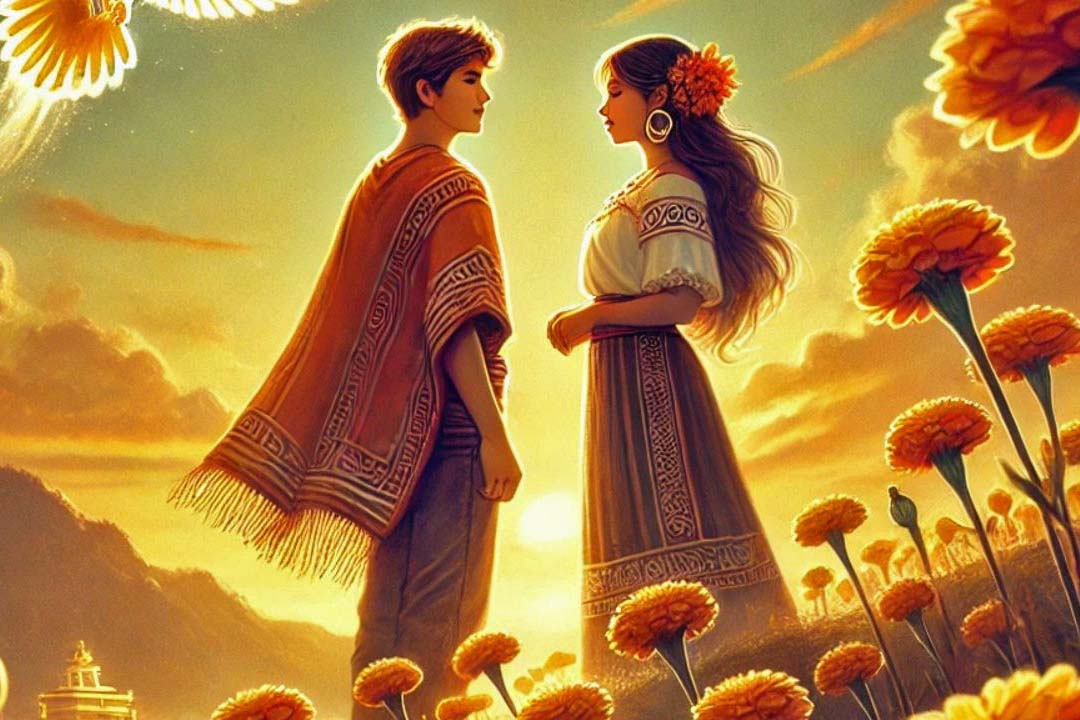
The legend of the cempasúchil flower (the Mexican marigold) is a beautiful Aztec myth about eternal love, transformation, and the origin of the traditional Day of the Dead flower.
The story begins with two young Aztecs, a girl named Xóchitl (“flower” in Nahuatl) and a boy named Huitzilin (“hummingbird”). They grew up together, and their childhood friendship blossomed into a deep, profound love.
Every afternoon, the young lovers would climb to the top of a mountain to offer gifts to Tonatiuh, the Sun God, who would shine down warmly on them. At the peak of the mountain, they swore an oath to love each other forever, spanning across life and even surviving death.
Their peaceful lives were shattered when war broke out, and Huitzilin was called away to defend his people in battle. Not long after, devastating news reached Xóchitl: her beloved Huitzilin had been fatally wounded and died on the battlefield.
Overwhelmed by intense grief and a broken heart, Xóchitl ran back up the mountain and pleaded with Tonatiuh to relieve her sorrow and reunite her with her true love.
Moved by her immense pain, the Sun God threw down a brilliant golden ray of light. The moment the sunbeam touched Xóchitl, she was transformed into a beautiful flower bud that remained tightly closed upon the earth.
Soon after, a small, radiant hummingbird flew over the field. It was the spirit of Huitzilin, who had taken the form of a bird to return to her. As the hummingbird gently perched upon the closed leaves, the flower recognized her lover’s touch and instantly bloomed. It opened up its twenty petals, releasing a powerful, magnificent aroma and glowing with a brilliant yellow-orange hue like the sun itself.
Tonatiuh then decreed that their love would remain immortal, declaring that as long as hummingbirds and cempasúchil flowers exist, the love of Xóchitl and Huitzilin will endure.
Because of this legend, the cempasúchil flower whose name stems from the Nahuatl word cempohualxochitl, meaning “flower of twenty petals” became deeply integrated into Día de los Muertos rituals.
Every year, families use the vibrant orange petals to scatter pathways and decorate traditional altars (ofrendas). It is believed that the flower’s bright, sun-like color and strong earthy fragrance light the way and guide the souls of ancestors back from Mictlán (the underworld) to visit the living world.
The Cempasuchil – marigold in the genus Tagetes are native to Mexico (as well as parts of Central America and the southwestern United States). The most famous species is Tagetes erecta (known as cempasúchil or the Aztec marigold), which grows wild across Mexican states like Michoacán, Puebla, Veracruz, Guerrero, and the State of México. Indigenous Mesoamerican peoples cultivated the flower for over 3,000 years for traditional medicine and sacred rituals.
Efrain Gonzalez Espinoza
Somos Language and Art Center
San Miguel de Allende GTO
Leave a Review