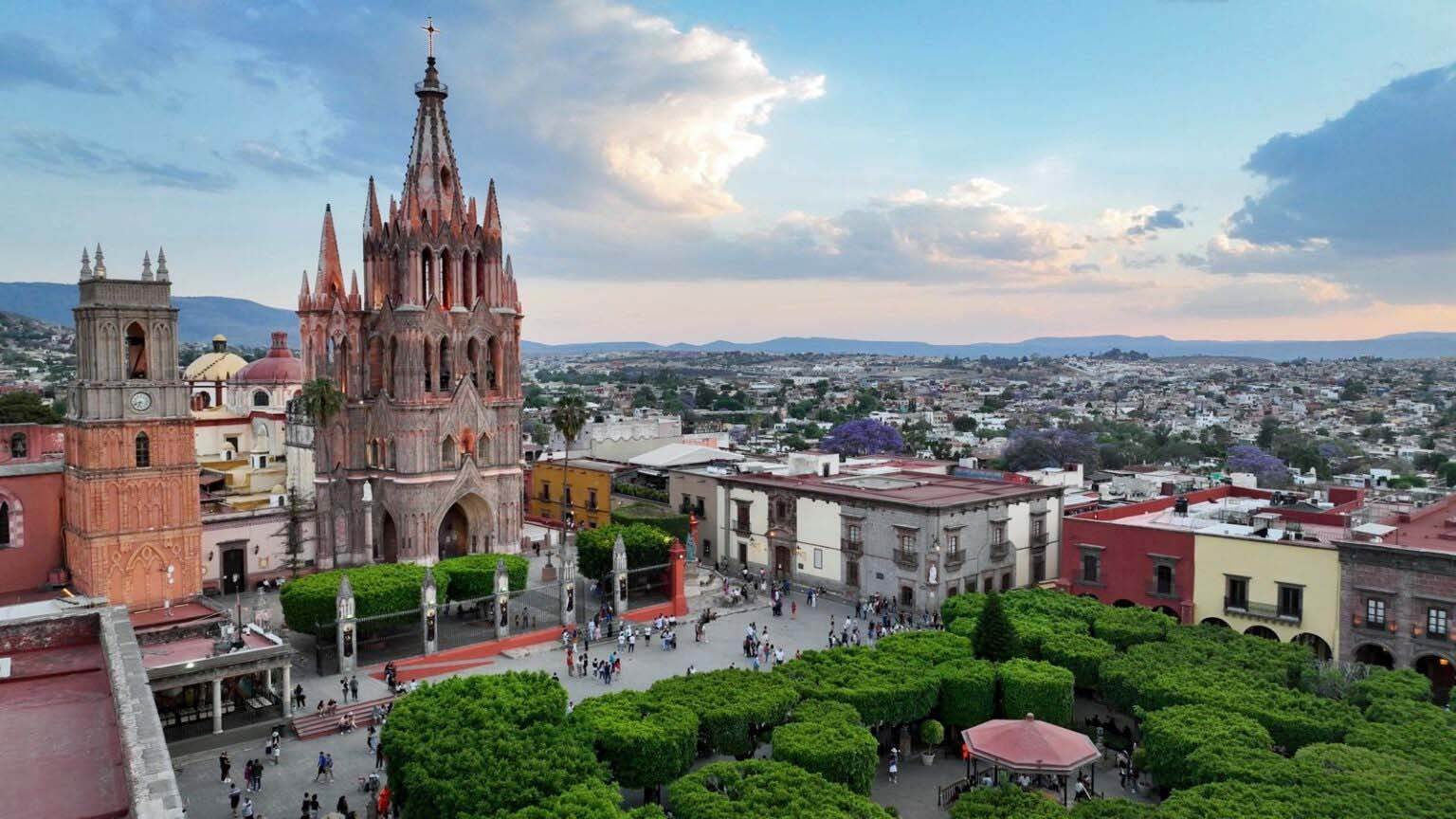
Some cities face the primary challenge of growing. San Miguel de Allende faces a more complex one: continuing to grow without losing what made its success possible.
The city is a World Heritage Site, an international tourist destination, and one of Guanajuato’s most globally recognized assets. But behind that postcard-perfect image lies a municipality that needs water, safety, housing, infrastructure, transportation, jobs, and services for those who live there every day.
For Mauricio Trejo, the mayor, this tension between preservation and development is the starting point for understanding his approach to governance. After serving several terms as mayor, his conclusion is that a city like San Miguel cannot be managed solely with a three-year perspective.
“The main achievement isn’t any one specific project. It’s having established a way of governing that allows us to know where we want to take San Miguel and what we need to do to get there,” he explains.
The municipal administration has dubbed this decision-making approach the “San Miguel Model.” It is not a specific program, but rather a cross-cutting framework encompassing planning, security, infrastructure, economic development, and identity, based on a simple premise: addressing the present without jeopardizing the future.
Growing Without Losing What Creates Value
Trejo often frames the discussion of urban growth in terms familiar to any entrepreneur: sustainability. A company can grow its sales while simultaneously eroding its profit margins or its brand. A city can grow to the point of compromising the assets that originally made it competitive: heritage, identity, urban landscape, water, safety, and an experience that is difficult to replicate.
That is why one of the most significant decisions in recent years was to place limits on unplanned growth. In 2021, the municipality faced a water shortage linked to urban expansion that had outpaced the capacity of its infrastructure. The response was to restrict real estate development in certain areas and reallocate infrastructure resources. The municipal government later reported that it had reversed that shortage and built up a reserve in its water networks.
“We have business leaders who understand that bringing order does not mean opposing investment. On the contrary: it means protecting existing investment and providing certainty for the investment we want to attract,” says Trejo.
This principle also underpins the update to the land-use plan with a vision toward 2050: determining in advance where San Miguel can grow and which areas should be preserved. In business terms, it means replacing improvisation with strategy.
From Tourist Destination to a Diversified Economy
For decades, San Miguel has built a powerful brand centered on tourism. The next challenge is to transform that prestige into a broader economic platform, without abandoning its core identity.
High-value-added tourism remains one of the driving forces: hospitality, gastronomy, winemaking, art, weddings, and international events form an ecosystem that extends far beyond hotel occupancy. Projects such as “Gema”—Gastronomy, Winemaking, Mixology, and Art—align with this approach: expanding the reasons to visit San Miguel and strengthening local economic chains. This new phase also incorporates industry and productive investment.
“We don’t want to stop being a tourism powerhouse. We want the child of a San Miguel family to have more options: to be able to work in tourism, but also in industry, technology, or by starting their own business,” says Trejo. Diversifying without losing our identity is one of the model’s main goals.
Trust Is Also Infrastructure
For a company, knowing the rules of the game reduces risk. For a city, maintaining order, services, and safety increases its competitiveness. The “San Miguel Model” deliberately links these two fronts.
“Without safety, there is no tourism, no investment, and no quality of life. For us, it’s not a separate issue from economic development; it’s a prerequisite for everything else to function,” notes the mayor.
The conceptual sequence is straightforward: safety builds trust, trust facilitates investment, and investment creates opportunities. Infrastructure operates in a similar way.
“A project shouldn’t be undertaken just because it looks good during a single administration. It has to solve a problem and remain useful for many years to come,” adds Trejo. This marks the shift from a government-led project approach to a city-wide infrastructure approach.
The government that people experience every day
Trejo attaches one condition to the narrative of competitiveness: economic indicators lose their meaning if they do not change everyday life. San Miguel’s success also creates new pressures—greater demand for housing, water, transportation, and services—which the model seeks to address alongside the competitiveness agenda.
“Economic development only makes sense when it ultimately creates opportunities and a better life for families. You can have a city full of investments, but if the people who live there don’t feel that their lives have improved, you’re doing something wrong,” he argues.
That vision also explains the importance he places on the relationship with the business sector: not only as a source of investment, but as a partner in building the city.
Experience as a Competitive Advantage
Having governed San Miguel de Allende during various terms has allowed Trejo to observe how a decision made years ago has lasting effects, and what problems can be anticipated before they turn into crises. Therein lies, perhaps, the most personal aspect of the model.
“When you govern for the first time, you think a lot about what you can accomplish over three years. With experience, you come to understand that the important decisions are the ones that continue to work even after you’re gone,” he explains.
This approach is similar to the philosophy of family-owned businesses in the Bajío region: institutionalizing to ensure continuity beyond individual leaders. The goal is not for future administrations to repeat the same decisions, but rather to leave behind capabilities, infrastructure, and a vision for the city that are solid enough so that San Miguel does not have to start from scratch every three years.
The Challenge of Success
Paradoxically, some of San Miguel’s main challenges stem from its own success: real estate pressure, increased demand for water and transportation, and the need to preserve what attracts visitors while new investment flows in.
That is why Trejo avoids framing the future solely in terms of growth. The question he puts on the table is a different one: What kind of city does San Miguel want to be in twenty years?
“Governing isn’t about managing what you inherited. It’s about making decisions to leave a city better prepared for what’s to come,” he concludes.
The “San Miguel Model” is not presented as an exportable formula or as a government brand. It is, in the mayor’s own words, an attempt to institutionalize a way of governing: protecting the assets that make a city competitive, correcting issues before they become irreversible, and building with a vision that extends beyond the term of the decision-maker.
Leave a Review