There is a time when San Miguel de Allende ceases to belong to the tourist brochures and once again belongs to its people. It doesn’t happen at noon, when the setting sun bathes the neo-Gothic façade of the Parish Church of San Miguel Arcángel in an ochre hue, but rather in the wee hours of the morning, around three or four a.m., when the darkness is at its thickest and the cold from the valley chills you to the bone.
It is the night of the last Friday in September or the early hours of the Saturday before the Feast of Saint Michael the Archangel (officially celebrated on September 29). For weeks, work has been going on in silence in the traditional neighborhoods: reed frames are assembled, brightly colored rice paper is pasted on, and wind instruments are tuned. La Alborada is not a spectacle produced for outside audiences; it is a collective promise that is renewed year after year.
The Origin: From the Textile Whistle to the Roar of Devotion
To understand the Alborada, we must go back to the mid-20th century, when San Miguel was not the gourmet destination or design capital we know today, but rather a town of workers, artisans, and farmers. Although veneration of the patron saint, Saint Michael the Archangel, dates back to the 16th century—with the founding of the town by Friar Juan de San Miguel—the contemporary Alborada took on its current form thanks to the workers at the iconic La Aurora Textile Factory.
Inspired by traditional celebrations in the north of the country and the Salvatierra region, the textile workers decided to organize an alborada to greet their patron saint at daybreak. With their own hands, they created stars out of paper and reed: lanterns illuminated from within that represent the guiding light, faith, and joy of the community.
Over the decades, residents of two other iconic neighborhoods with deeply rooted identities joined the initiative started by the La Aurora workers: La Estación (linked to the legacy of the railroad) and Valle del Maíz (guardian of indigenous traditions and the Santa Cruz).
The Procession: Three Rivers of Light Flowing Toward the Heart of the Town
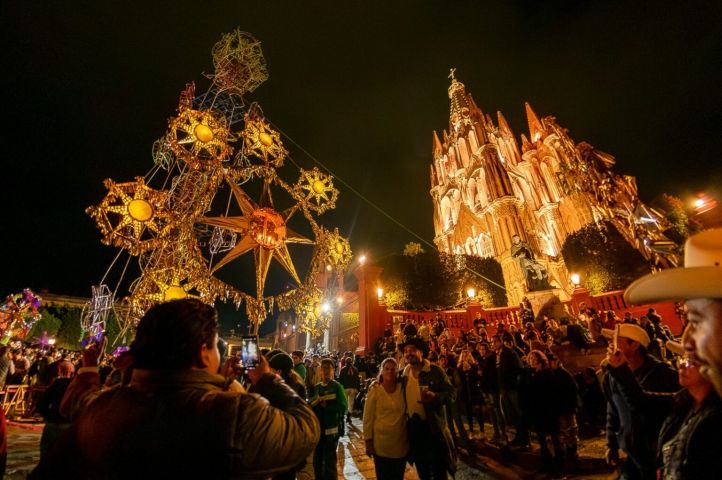
Around 3:00 a.m., while the city appears to be asleep, the neighborhoods come to life. In La Estación, La Aurora, and Valle del Maíz, hundreds of people gather. Entire families—grandparents carrying grandchildren on their shoulders, young people, and groups of musicians—carry giant paper stars suspended from wooden poles.
To the rhythm of the marching bands playing marches and double-time tunes, the three contingents begin their march toward the Historic Center. They are three human rivers advancing through the twilight, illuminating the cobblestone streets with the flickering glow of the paper stars. The smell of gunpowder begins to mingle with the steam rising from the café de olla, atole, and ponche being handed out to the marchers.
Upon reaching the Main Garden, in front of the parish church, the three processions merge into a single festive crowd. Thousands of people await the climactic moment.
At exactly 4:00 a.m., the night gives way: the fireworks display begins. Tons of fireworks blaze simultaneously in the San Miguel sky for nearly an hour. The night sky turns to day in bursts of red, green, gold, and silver light, accompanied by the thunderous ringing of bells and the song “Las Mañanitas” sung in unison by the crowd. It is the symbolic triumph of Saint Michael the Archangel over darkness.
The Legacy That Never Fades
As the last fireworks burn out and the white smoke, scented with sulfur, dissipates among the arcades of the Main Garden, the first rays of the morning sun begin to gild the pink stone of the parish church. The people, weary but smiling, begin to disperse toward the markets and eateries to regain their strength with a bowl of menudo or a plate of pozole.
The Alborada comes to an end, but San Miguel de Allende reaffirms its identity. In a rapidly changing world, a city’s ability to preserve its collective memory does not lie in isolating it, but in creating the conditions of order and safety so that new generations can continue to light the reed stars every September dawn.
Leave a Review