Thursday, October 23 | 5:00 pm
Sala Quetzal in La Biblioteca Pública
Free entry
English talk with Spanish translation
What began as one woman’s environmental awakening in the Mexican countryside has evolved into a powerful artistic statement now captured in book form that brings urgent climate messages to readers worldwide.
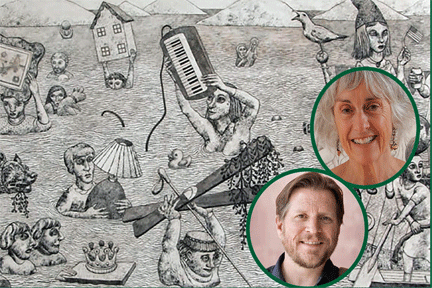
British-born artist Erica Daborn’s “Dialogues with Mother Earth: Drawing to Save the Planet” transforms her series of 13 massive charcoal murals, some stretching over 15 feet long (4.5 meters), into an accessible educational resource created in partnership with Caminos de Agua, San Miguel de Allende’s leading water sustainability organization.
The collaboration represents the culmination of a 15-year artistic journey that began during Daborn’s 2010 sabbatical year living in a rural Mexican hacienda, where proximity to the natural world sparked her environmental consciousness.
“I was living in the campo in an old hacienda and being in the countryside I felt the need to do something,” Daborn recalls. The turning point came from an unexpected source: her students’ frustration. “A lot of young people were asking about climate change and why no one was doing anything about it.”
As a result, Daborn devised this educational project to help people who haven’t really thought about these issues: “To understand that we’ve all contributed to the problem And because scientific facts don’t work, I devised a series of visual stories that capture the imagination and bring viewers to explore the issues in an accessible form.”
Documenting Future History
The resulting murals follow in the tradition of historically significant works like the Hiroshima murals in Japan and Diego Rivera’s documentation of Mexican history. But Daborn’s approach is uniquely forward-looking.
“We’re in the future looking back,” she explains. “Let’s look back and make sure we documented that.”
Originally conceived as part of a complex installation featuring fires, floods, and cave-like spaces, Daborn discovered the murals’ standalone power. “I realized I didn’t need the installation. The murals speak for themselves.” And the choice of charcoal as her medium? Daborn says the medium connects viewers to humanity’s earliest artistic expressions. “Charcoal creates that textured surface. It’s the perfect medium,” she says, referencing prehistoric cave paintings that first captured humanity’s relationship with the natural world.
Beyond Facts and Figures
Unlike data-heavy environmental presentations, Daborn’s visual stories invite personal reflection. “Al Gore was all facts and figures,” she notes. “The drawings are a way to get you into the story. You look at the drawings and you ask yourself what is going on.”
The title “Dialogues with Mother Earth” reflects this interactive approach. “It’s an interaction. You look at the images and ask yourself what’s going on here. Do I care about this? You start asking questions and having a conversation with the images.”
The timing proves eerily prescient. During one presentation, Daborn had just completed a mural showing people holding various water vessels with numbers. “The front page of the New York Times that same day featured a story about a town in South Africa that had no water,” said Daborn.
Local Partnership, Global Message
The collaboration with Caminos de Agua emerged naturally from shared missions. “Caminos is working to mitigate issues around depletion of resources, and a lot of the climate issues are related to that, and they are the ones doing something about it. There was a real connection.”
Dylan Terrell of Caminos de Agua has been “super supportive and helpful,” according to Daborn, though the project faced delays. “We kind of abandoned it in 2021 and not until now we were able to get the book out.”
“This project was years in the making and even stalled during the pandemic as we balanced fundraising and urgent community needs. That’s why it’s so powerful to finally see it come to life with Erica. Complex issues like the water and climate crises can be hard to communicate, but through Erica’s art they become accessible, emotional, and impossible to ignore,’ said Terrell.
Maintaining Hope in Dark Times
Living off-grid herself, Daborn acknowledges the challenge of maintaining optimism while documenting environmental catastrophe. “I’m not sure I do maintain hope,” she admits candidly. “I think your average person is not thinking about it, and that was the reason for this project.”
The book format represents both practical necessity and expanded opportunity. While Daborn would “love to get [the murals] out to more venues,” including to her native England, it’s difficult to find venues to host the exhibit. . But with 500 copies printed, the book ensures.


Caminos de Agua is a community focused, data-driven, and science-oriented non-governmental organization (NGO) based in San Miguel de Allende. We drive to empower local at-risk communities to obtain adequate supplies of safe and healthy drinking water. Today, Caminos de Agua is a team of ten full- and part-time employees, plus several graduate-level engineering and public interest interns from Engineers Without Borders UK and other universities and institutions. We’re a mix of expat residents and Mexicans, technologists and community organizers, researchers and educators, united by our concern for public health and welfare. Caminos de Agua is organized as a registered nonprofit in both the U.S. and Mexico. At Caminos de Agua, we believe that access to safe, healthy drinking water should be a fundamental human right. We help communities at risk confront challenges of water quality and scarcity through:
1. Water monitoring 2. Education 3. Community-led solutions 4. Research and development 5. Activism