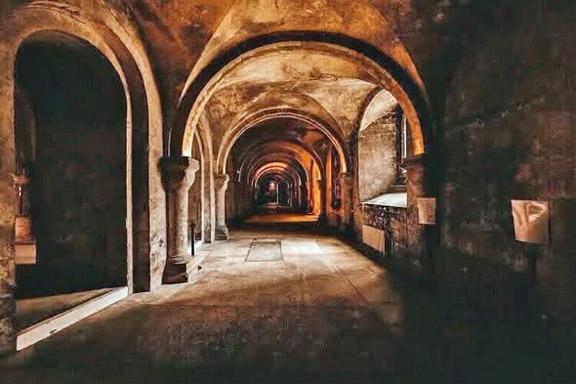
On November 1st and 2nd, the catacombs at the Parish of San Miguel Arcángel will be open to the public. Most notably, the remains of Mexico’s fifth president, Anastasio Bustamante, are interred there.
During the emperor’s visit to San Miguel de Allende on September 14, 1864, the country’s second emperor, Maximilian of Habsburg, visited these catacombs on September 14, 1864, specifically stopping at Bustamante’s tombstone—and ordered that a plaque be placed in his honor, as he considered Bustamante a friend and a loyal supporter of his cause.
These crypts remain closed to the public throughout the year; they are opened only during the Day of the Dead season, allowing visitors to see the tombs located beneath the parish.
Here, you will discover another marvel within this iconic parish, which serves as the final resting place for various residents of San Miguel, several priests, and a former president of Mexico.
The entrance is situated in front of the main altar, where wooden doors open to reveal a tunnel leading to the catacombs—a structure attributed to the architect Francisco Eduardo Tresguerras, a native of Guanajuato, who worked on the project in 1930.
Mexican President Anastasio Bustamante fought against the insurgents between 1810 and 1821 and assumed the presidency in 1830; however, he was forced to step down in 1833 following protests sparked by his role in the assassination of Vicente Guerrero. He later returned to the presidency, serving from 1837 to 1839. Upon his retirement, he moved to San Miguel de Allende, residing in a house on Calle San Francisco. Following his death, his remains were interred in the parish crypt, where a Mexican flag now rests above his tomb.
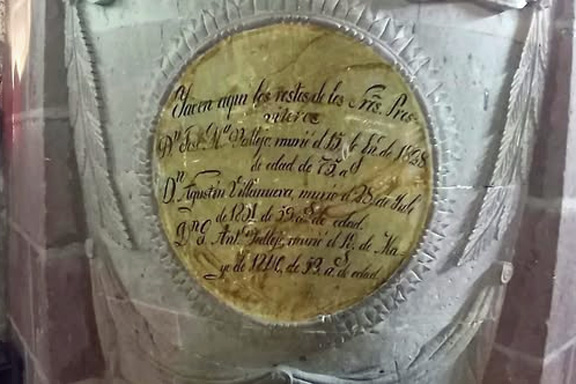
At this site, there is a window, beneath which lies the tomb of Father Juan Manuel Villegas parish priest of San Miguel from 1736 to 1776, and reportedly a commissioner for the Holy Inquisition. He was originally interred in the parish cemetery, but his remains were moved to the crypt in 1842.
This remarkable space also holds the remains of Father Francisco de Uranga, who passed away in 1830 and served as the parish priest of San Miguel at the time the War of Independence began.
Another tomb that draws particular attention is that of the priest José M. Vallejo, who died in 1928. These beautiful site is opened to the general public only on November 1st and 2nd.
Sorry, no records were found. Please adjust your search criteria and try again.
Sorry, unable to load the Maps API.